Mental Skills for Athletes
Strong minds create strong athletes.
Mental skills — like focus, confidence, and staying calm under pressure — are just as important as physical skills in sports. They help you bounce back from mistakes, handle stress, and stay motivated…even when things get tough.
With strong mental skills, you don’t just play better — you enjoy the game more, work better with teammates, and grow stronger on and off the field.
Here you’ll learn about the Top 5 MENTAL SKILLS for elite athletic performance, and the TOOLS that’ll help you master them…
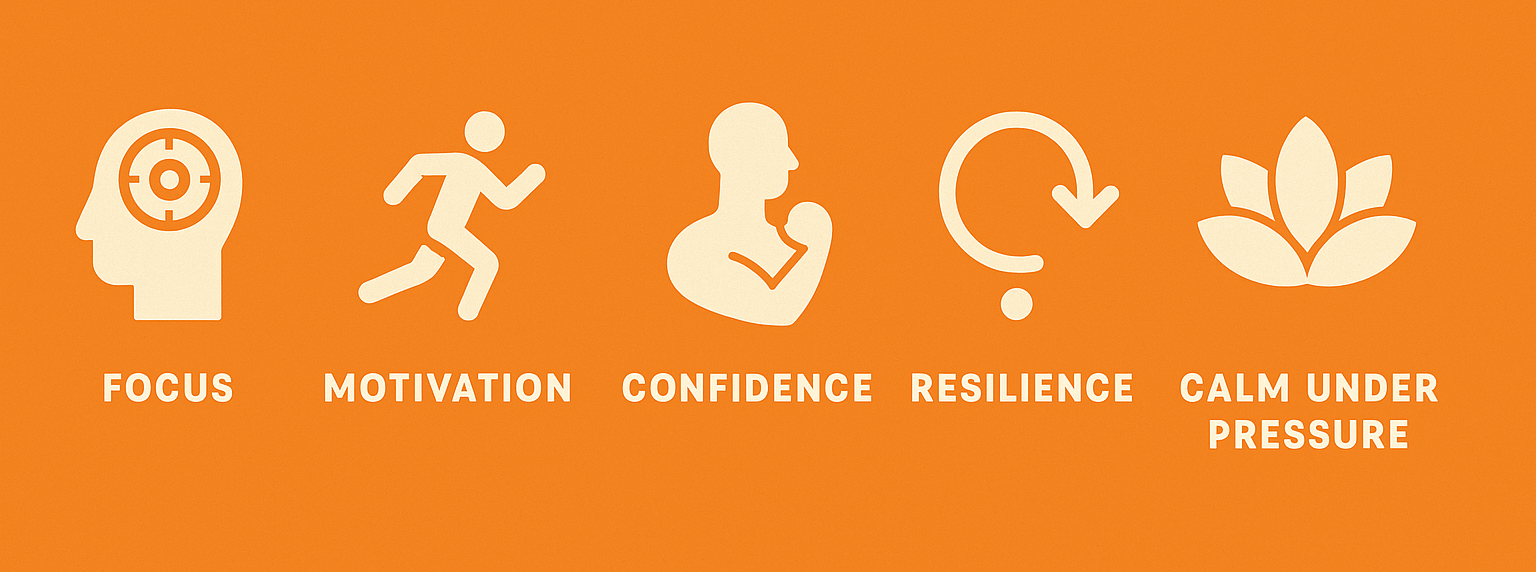
ROADMAP to MENTAL TOUGHNESS:
The Top 5 Mental Skills Every Athlete Needs
1
FOCUS
What is focus?
The ability to block out distractions and stay “locked in,” giving your full attention to the play, drill, or moment right in front of you.
When do you need it?
A soccer player lining up for a penalty kick needs total focus to block out the crowd and zero in on the ball.
A softball pitcher needs sharp focus as she stares down the batter, tuning out the noise from the dugout and locking in on the catcher’s glove.
A basketball player needs focus at the free-throw line, blocking out the jeering crowd and visualizing the ball swishing through the net.
2
3
MOTIVATION
What is motivation?
The inner drive that pushes you to practice hard, keep improving, and chase your goals — even when it’s not easy.
When do you need it?
In the 400-meter dash, a runner feels her lungs burning on the final turn but drives harder, remembering the race she lost by a fraction of a second last season.
Down by one with 30 seconds left, a lacrosse attacker cuts through two defenders, fueled by the goal she promised her teammates she’d score.
At the last flip turn of the 100-meter freestyle, a swimmer sees his rival’s splash just ahead and kicks harder, chasing that personal record he’s missed by half a second all year.
CONFIDENCE
What is confidence?
Believing in yourself and and your skills, and trusting that you can perform well — even when things get tough or uncertain.
When do you need it?
After missing her last serve, a player confidently tosses the ball again, locks eyes on the back line, and nails an ace that clips the corner.
With two outs and runners on base, a shortstop charges a slow roller and fires to first without hesitation—trusting the countless reps he’s put in.
On fourth down, a receiver calls for the deep route she’s practiced all week, catches the spiral over her shoulder, and sprints untouched into the end zone.
4
RESILIENCE
What is resilience?
Bouncing back from mistakes, losses or injuries quickly, without letting them break your spirit or resolve.
When do you need it?
After losing the first set 6–0, a tennis player resets her mindset, adjusts her strategy, and battles back to win the next two sets.
After slipping on the uneven bars during warm-ups, a gymnast refocuses, shakes off the nerves, and sticks her routine when it counts.
After accidentally turning the ball over for a goal, a defender hustles back the next play, intercepts a pass, and starts the counterattack that ties the game.
5
COMPOSURE (“handling pressure”)
What is composure / handling pressure?
Staying calm, clear-headed and steady in high-pressure moments and circumstances.
When do you need it?
With the gold medal on the line and one jump left, a skater feels the weight of every eye in the arena, steadies her nerves, and launches into a flawless triple lutz.
A team captain handles the pressure of being a top seed expected to win a tournament.
During sudden death overtime, a player maintains steady passes and communication instead of panicking and forcing plays.